Thursday, January 29, 2015

Recess-the Silverlining for Kids


My days of waiting in line for the tire swing and making an obstacle course within the jungle gym is no longer, but to millions of Elementary School kids those times are still the highlight of their school days.
A loving Mom relays the importance recess plays in the eyes of her 9 year old son- “to him it is everything, it his world” (Krischer).  Because recess is so important to young children it seems to be a good punishment for when bad behavior ensues—right? Not so much according to parents and many health officials.


Many school systems have turned to taking away recess as punishment in an attempt to control “those wild kids.”  But, is this really a good form of punishment in a country where childhood obesity is at an all-time high of 18%? 
 Recess for kids is a time to release energy they build up while confined in a classroom.  A time for exercise in a fun and thrilling way.  One school district banned the banning of recess (say that two times fast) for punishments, because they realized the importance it had on growing healthy kids.  The prevention of overweight (affecting 1/3 of the young population) and obese children lies within physical activity—or in kids’ minds', recess.

Recess is not just the answer to more physical activity for kids, but it is an energy outlet helping kids reach their maximum potential in the classroom.  One Mother, a family physician, found her son coming home with disciplinary notes from his teacher.  When she confronted her son about why he was struggling, he told her he couldn't keep his legs still; his 15 minute recess time was not enough for his energy to be released.  If a story like this is true for many kids the punishment of taking away recess would be counterproductive- less exercise would create worse behavior.  As the kids would way: let there be recess!


The Health of Our Nation, and What's Not Being Done About It

As with many aspects of how the U.S. operates, our initial expectation is often times different than the reality. Cash crops run our nation; corn, wheat, and soy products are used to create the seemingly endless supply of packaged goods that are plunging our nation into a state of increasing obesity. The foods that are made out of these products are consistently high in empty calories, high in sodium, and of course, very high in sugar. At the same time, these packaged goods lack many nutrients that the body needs for its regular functions; such as fiber, calcium, iron, and vitamins that are absorbed naturally (and not the kind that is concentrated into a pill.)


It seems that the problem has been so apparent for so long, so why hasn't it been fixed yet? Shouldn't we be able to just redirect more government spending from the current major cash crops, over to the other healthier alternatives? Not only do we need a change in government, we also need a change in culture. As American's we need to realize the truth behind "ready to eat" snacks, and divert our hunger towards a more beneficial alternative. In our culture it seems as if the norm is to always be moving and to always be working, and as a result this leaves very little time for not only taking the time to choose what we may think is the right thing to eat, but it also restricts our time spent eating as well. Eating slower has many health benefits, but that is a blog post for another day. We cannot simply point the finger at the government for all of the issues regarding this topic, because we are at fault in many respects as well.


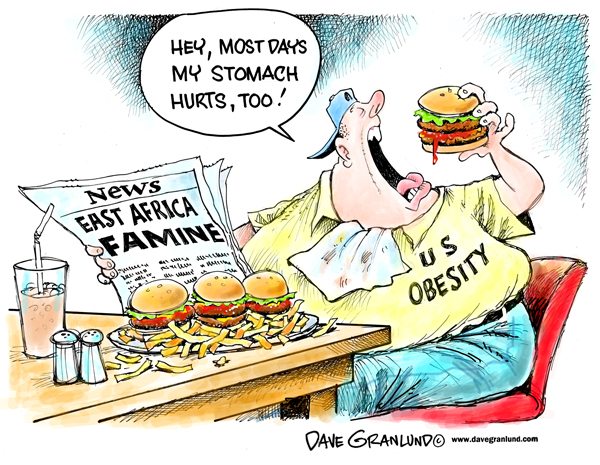
Obesity is now rivaling hunger as a global issue, and many countries in the world seem to be following the same pattern of unhealthy eating. If we are to reverse that seemingly irreversible damage that the american diet has enacted upon its citizens, we need to make our government care. We must emphasize the sheer importance of a balanced diet, not one that purely consists of only a couple of the food groups. The main goal we should have in mind is to not only improve the health of our nature, but to ensure that our future generation has the right mindset about healthy eating so that they too can lead us into a brighter future.


Sources:
"Do You Have ANY Idea How Absurd U.S. Farm Subsidies Are?" Mercola.com. N.p., n.d. Web. 29 Jan. 2015.

"What Vitamins and Supplements Can and Can't Do." WebMD. WebMD, n.d. Web. 29 Jan. 2015.

"Zen Habits : Breathe." Zen Habits RSS. N.p., n.d. Web. 29 Jan. 2015.

Wednesday, January 28, 2015

Overweight and Poor


What do you think of when you think of children in poverty? Do you think of kids who are skin and bones, with ribs sticking out? Yeah well that is not me.

I am an eleven year old girl who is overweight. To the world, I am fat because I like to eat junk food or I have no self-control over the type of foods that I eat. But that is not the case. I want fruits, vegetables and grains. But my mom says we can’t afford it.

At the store, I point towards the apples and bananas but mom says not today. Instead she grabs cookies off the shelf and says that it can be my afternoon snack. I don’t mind because I like the cookies. I heard that people used to think that fat people were rich. That is not the case anymore. There are 50.2 million people starving in the US but diabetes and other diet-related diseases are at its highest. People look at me and think that I eat too much and am too lazy. But what people don’t understand is that I am just a kid, who eats what her mom can afford. My mom works every day and sometimes on the weekend, but she still says it is hard to buy the healthy food.

Because my mom cannot afford the healthy foods at the store, I am 1.7 times more likely to be severely obese than you. People want me to be skinny and healthy but mom says we can’t afford it. Why do they make these things unaffordable? Why don’t people seem to care about my health?

I am 1 of 46 million Americans living in poverty with my mom. So why don’t people understand why I am “obese”? My body cannot metabolize and store food properly because most of my life, we have lived in poverty. So I store it as fat instead. Obesity rates increased by 23% from 2003 to 2007 for kids like me, kids who have parents who little or no more. Please help. Because I am not just a fat eleven year old. I am a little girl who cannot afford those healthy foods. If people don’t help children like me, obesity rates will double in just 15 years.


Think about the future of your children.

 
Sources:
Patel, R. (2008). Stuffed and starved: The hidden battle for the world food system. Brooklyn, N.Y: Melville House Pub.

Tuesday, January 27, 2015

Overpopulation Causing Hunger Worldwide?

Have you ever thought our World would come to the point where we would result in a population crash? Or have so many people that not everyone is being fed? Thomas Malthus's An Essay on the Principle of Population, is one of the most controversial works known to man about population. The basic overview of An Essay on the Principle of Population is that population growth continues to grow until it hits social limits, which is poverty and hunger. 


We tend to think of the overpopulated areas of the world are countries that are high in poverty and low levels of human development. Out of these 29 countries that struggle with poverty and low levels of human development, about a dozen of them are growing at three percent or more. For example: 

"Niger, currently the world's fastest growing country, has 15.9 million people as of 2010 but is growing at 3.66 percent a year, which if unchecked would give it a population of 617.9 million in 2110 -twice as large as the United States today."

The picture of the left compares how big Niger is to the United States. After reading the quote in Chapter 4 of Bell (above). It makes me wonder how much more poverty and human development would be prominent? "The WFP says 3.6 million of Niger's 11.5 million people face food shortages, while 2.5 million are on the brink of starvation." Obviously, starvation and food shortages is a huge problem for our World and not a lot is being done about it. America, as one of the leading countries in the world should put their foot down and do something about this. We have so much leftover food we just put to waste, whether it is at home, at the school cafeteria, or at a well-known restaurant, food is being put to waste. Instead of putting all of this food to waste, I think we and other countries should create a solution to the starvation and hunger across the world. If there enough food to feed everyone, then why are there millions of starving people today? Thomas Malthus makes a great point when it comes to population, but is population really the problem? Developed countries need to do a better job when it comes to helping the starving people. 


Sources:


https://www.wfp.org/countries/niger

http://www.ifitweremyhome.com/compare/US/NE

 http://www.paulchefurka.ca/Overpopulation.jpg

Bell, Michael. "Chapter 4." An Invitation to Environmental Sociology. Thousand Oaks: Pine Forge, 1998. N. pag. Print.

So Many Mouths to Feed

Dear reader,

               Let me ask you a series of questions. Think back to yesterday, or the day before, or however far back you can remember. What did you have for breakfast? Maybe you had eggs, waffles, toast, or a bowl of cereal. Maybe you're like me and you skipped breakfast all together and instead waited till lunch to get your fill. Do you remember what you had then? What about dinner? Was it a home cooked meal, did you go out to eat, or (if you're a poor college student like myself) did you settle for whatever choices the cafeteria decided to throw together?

Did you have choices for every meal?

Were you actually worried about where your next meal was going to come from, or have you been living each day in full confidence that you wouldn't miss a meal? 


If you haven't, than you are the lucky 85.7 %

What does this mean you may ask? 

This means, that in 2013, 14.3% of households in the US had no idea where or when their next meal would be.  We call this: Food Insecurity, and it's a very big and very real problem in this country.

Now, 14% doesn't seem like a lot so let's look at this number in a different (but true) light:


You are a 3rd grade teacher. In your class there are 25 bright and talented kids loaded with potential. 25 kids who you have worked closely with to encourage their growth and development. 25 kids who you treat like your own children. .

Now imagine 4 of these children struggling each and every day to pay attention. They want to, they really do, but something is occupying their minds to the point that anything you do is futile. As their teacher you are worried and decide to confront the parent(s) of one of these children.

You call the parent in to your office hoping to find a solution to the child's suffering. When you ask about problems at home the parent breaks down into a flood of tears. What you find out is that the child is starving. Their parents are starving. Each and everyday is a battle to put food on the table. In fact, the only sure meal the child gets is during school lunch time. And not even that is faithful. For one, school lunches are no good source of nutrition. Second, there is the problem of weekends and vacation weeks where the school is closed.

High costs of living plus low income makes 4 out of 25 kids who are silently suffering because their family can't afford to keep food on the table.  And even when they can afford food, it's almost impossible to afford fresh food like fruits and vegetables.

What problem does this cause? Well, if families can't afford nutrition filled foods, they are forced to purchase inexpensive calorie filled food. In turn, more and more kids in the US are victim to obesity and many other diseases.

By now I'm sure you're wondering what exactly this has to do with environmental sociology? The answer: externality.

An externality is a cost or benefit that someone goes through even though they didn't choose to.

You see, because of the business of agriculture and the rise in food prices, people can't afford to live healthy. The families who suffer from food insecurity didn't choose to. They are an externality. They are only paying the prices that the growing industrialization of agriculture causes.


So while you're munching away (as I'm sure many of you are right now) on your processed bag of chips or cup of grapes, take a moment to appreciate it.

You have a choice that many people don't.

So now the question is: How can you help?

Well the first thing you have to do is talk about it! Talk about the problem of hunger. Make it known. It's not just a foreign problem that only happens in 3rd world countries. It's here to. Hunger is a universal problem so it needs to be talked about.

The next step depends on you.

Here is a link to the Feeding America site. An organization that fights hunger in America.

Here is a link to an international food charity!


Don't forget to check your local organizations for volunteer opportunities.

Be active, save lives, and fight hunger.


Sources:
Bell, Michael. An Invitation to Environmental Sociology. Thousand Oaks: Pine Forge, 1998. 34. Print.

Patel, R. (2008). Stuffed and starved: The hidden battle for the world food system. Brooklyn, N.Y: Melville House Pub.
http://www.ers.usda.gov/topics/food-nutrition-assistance/food-security-in-the-us.aspx



Don't Kill Me For Soup


We’ve all heard the iconic tune: duunnndunnn... duuuunnnn duun... duuunnnnnnnn dun dun dun dun dun dun dun dun dun dundunnnnnnnnnnn dunnnn. I’m sure your heart is racing with just hearing it. This misconception about our species evokes such a strong response from humans that just saying a couple of dunnnn duns in the right way immediately brings up my image. Or really, some scary version of myself:

Yup, that’s me. Actually, it’s just a terrible picture of me. So let’s replace that picture with something a little more flattering, not to mention friendlier.


Much better. So, you must be wondering, why on earth is a shark writing a blog post? And better yet, why should you care? Well, I’m here to tell you why. Sharks have been misconstrued as evil, dangerous, man-eating creatures ever since the movie Jaws was released. I would like to set the record straight. We did not suddenly show up, disrupt your lives and eat you. We have been around for over 400 million years, while you humans (or actually the ancestors of modern day humans) have been here for about 6 million years. That’s a 394 million year gap but hey, whose counting? It’s a harsh reality, but you are the ones doing the damage, not us. Sharks have been known to bite, on average, 50 people each year, only killing about 10 people per year. Shark attacks are dangerous, yes, but we only attack if provoked or if we confuse you with our prey. In contrast to us killing about 10 of you per year, you kill up to 100 million sharks per year. Why so many? Some of us get stuck in the fishing nets and are left to die. Most of us are used to make shark fin soup, a delicacy in China. At first, the meal was quite rare, but now with the technology you have available to kill so many of us each day, the meal is becoming more available and common.


Why should you care about this? Morally and ethically, you should care. The way we are killed is barbaric. We are captured in fishing nets, called long-lines, and hauled onto deck by fishermen. Then, while still alive, you slice off our fins and tail and throw us back overboard, still alive and suffering. This is barbaric. And for what? For soup. We are portrayed as destructive, dangerous and innately evil animals while you cut us apart still alive. We grow slowly and do not have many offspring. We cannot reproduce fast enough to compensate for the millions killed each year. For one second, try to place yourselves in our situation. Imagine being snatched from your home, having your limbs cut off while still alive, and put back in your home to suffer and die an unbearably painful death. If someone did this, even just once, to their own species, the perpetrator would be punished and brought to justice. It would be inexcusable if it happened to you but it happens to us every day, 365 days a year. Millions of sharks are killed in the most inhumane way, with no regard for our lives. Biologically, we are just as sensitive as you. We have pain receptors and nerves; we feel each minute of our torturous end. All because in your society, or predominantly in the society of one country, you enjoy one type of soup. One delicacy has impacted the entire ecosystem of the oceans, not to mention it has called into question the ethics and moral standards of the human race.

Ok, so let’s say that you don’t care that you are cutting us up still alive and dumping our mutilated bodies back in the ocean to suffer until we die….for soup. We will go extinct, and this will have many repercussions. If you kill us, we won’t feed on enough stingrays and other predators. Their numbers will grow, causing whatever they eat to decrease in numbers. This causes the prey of the stingray’s prey to increase, and so on. The entire balance of the ecosystem will be unstable. Some species will grow, causing others to die, upsetting the fragile ecosystem. Whether you like it or not, this will affect you. This is called “the cascade effect” and ultimately will destroy the health of coral reefs.
 

This is my home. This ecosystem is in danger of being completely demolished because of your actions.

My home is beautiful and I have a right to live here. A sociologist, Michael Mayerfeld Bell, came up with the term the beauty of ecology. This term refers to the right of every living thing to “a home, a habitat, that is sustainably beautiful and beautifully sustainable" (Bell, 34). We have a right to our home; we occupied this planet millions of years before you ever did. We are not man-hungry, satanic animals. We are just trying to survive like everyone else.


You have allowed one soup to destroy our ecosystem and endanger our species, putting many species at risk. I’ll leave you to ponder this: if you allow one soup primarily in one country, out of 196 countries, to create so much turmoil and be so destructive, what will you allow to happen to items desired by multiple countries? Will you do something about this, or will you ignore it? Will you investigate the ramifications and inquire about your actions or will you continue to disregard life and continue on your selfish and materialistic warpath?


Sources:

Earle, Sylvia A. The World Is Blue: How Our Fate and the Ocean's Are One. Washington, D.C.: National Geographic, 2009. 62-64. Print.

Earle, Sylvia A. Sea Change: A Message of the Oceans. New York: G.P. Putnam's Sons, 1995. 216-17. Print.

Bell, Michael. An Invitation to Environmental Sociology. Thousand Oaks: Pine Forge, 1998. 34. Print.

https://www.youtube.com/watch?v=wCfWHqrYUqo

https://www.youtube.com/watch?v=miEX89E-pvM

https://www.youtube.com/watch?v=yzlqXMateRE

Thursday, January 22, 2015

Think Before You Eat


Don’t you just love the feeling of sitting down and eating a nice meal, and the feeling of being full afterwards? Have you ever looked down and seen that there is a lot of food on your plate but didn’t care because you were just too full?
               According to “Love Food, Hate Waste” the average American wastes about 1 pound of food per day. This is something that I find disturbing after reading from the book “Stuffed and Starved”. This book really highlighted to me that America is one of the most over-weight societies and talks about how we are consuming twice the amount of food that we actually need. This bothers me because it also talks about all the countries that struggle to feed one person let alone their whole family.
              
 Whenever I am in my schools local cafeteria there is an area that you put all of your plates and bowls so they can be cleaned. Most of those plates and bowls are still piled high with foods that are just going to waste without any thought. Also, at the end of the day there is always a ton of left over food in which they completely just throw away. To me, it makes me upset to think that all these people can enjoy a nice buffet style meal and just throw away piles of food, while there are probably people in the local community that may not be eating that night.
               I had read in a magazine about a group of people who visit local restaurants and super markets that are throwing away food that has either not been eaten for the night or things from the super market that are still good to eat but are required to be taken off the shelves, and gone around the city and gave these left over foods to homeless people who didn’t have a meal that day. I believe this idea should be on a much wider scale.

               Whenever I was a kid I always heard from my parents that I need to eat everything on my plate and not to waste anything because there was someone out there who would love to be able to eat a good meal. This is something that a lot of people probably heard when they were little and really never thought much of it. I think that there are a lot of people in America that are naive to the fact that millions of people are starving every night. I feel that this issue should become a bigger topic and inform people about what is going on out there and maybe it will help you the next time you decide to completely fill your plate up or whenever you are about to throw away perfectly good food.

               Going to sleep hungry is an issue that many people deal with and I feel that not everyone could be helped by doing some of these solutions but a large portion of it could which would make a lot of difference. To find out ways to help you can visit NoKidHungry.org


dining.ucdavis.edu/documents/FoodWaste-nov.09.pdf
Stuffed and Starved, Raj Patel, Melville House Publishing,